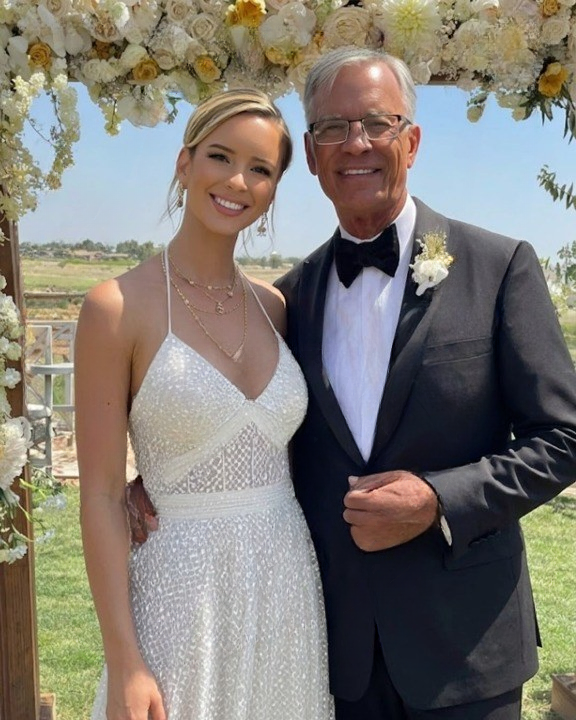
I never thought I would become the kind of person who agreed to a marriage like that.
If you had known me before everything changed, you would have called me careful, maybe even invisible. I learned early how to survive without drawing attention. At sixteen, I perfected the art of standing in a room without being truly seen—laughing a second too late, smiling when expected, and pretending that solitude was something I chose rather than something that chose me first.
Then Violet came into my life and disrupted that careful balance. She didn’t just tolerate me; she noticed me. That alone felt suspicious at first, like a mistake someone would eventually correct. But she stayed—through school, through late-night talks, through the slow accumulation of years that I assumed would eventually reveal I didn’t belong beside her.
What I didn’t have was stability. What I did have was uncertainty: a strained family, an unstable living situation, and the quiet pressure of knowing I couldn’t afford to fall apart. When Violet moved into the city, I followed her, clinging to the one relationship that made life feel less temporary. My apartment was small, imperfect, and loud in all the wrong ways, but it was mine. That mattered more than I admitted out loud.
That was also how I met Rick—Violet’s grandfather.
He was not the kind of man who blended into the background. Rick noticed everything: the way people held their posture when they were lying, the hesitation before someone answered a question, the subtle shift in tone when money entered a conversation. Most importantly, he noticed me—not as Violet’s friend, but as someone with patterns of thought he found interesting.
“You think too much about cost,” he once said calmly during a Sunday dinner. “Not enough about value.”
I laughed it off, but he didn’t retract the statement. That was the beginning of a strange kind of understanding between us—one that never quite fit into any normal category.
Months passed before he asked me a question that shifted everything.
“Have you ever considered marrying for practical reasons?”
At first, I thought it was a joke. It wasn’t. Rick meant security. He meant structure. He meant control over the parts of life that had always been uncertain for me.
“You’re not impressed by wealth the way others pretend to be,” he said. “And you notice things people ignore. That matters more than you think.”
I should have walked away from that conversation. Instead, I asked why he would choose me.
“Because I trust you,” he replied simply. “And I don’t trust many people who already have everything.”
I didn’t say yes immediately. But I didn’t say no either.
When I told Violet, her reaction was immediate and sharp.
“You’re serious?” she asked, like she couldn’t reconcile the version of me she knew with the choice I was considering.
“It’s not what you think,” I tried to explain, but I couldn’t fully explain it even to myself.
Three weeks later, I married Rick.
The ceremony was quiet, restrained, almost unreal. His family attended with the kind of polite stiffness that barely disguised their judgment. I could feel their assumptions in every glance. I didn’t belong. I was an outsider who had stepped into a world that was not meant to include me.
Angela, his daughter, was the first to speak openly.
“You moved quickly,” she said, her tone carefully neutral.
“I tend to,” I replied. “Especially when people are watching too closely.”
That was the first time Rick intervened—not loudly, not dramatically, but with quiet authority. And just like that, the conversation ended.
Later that night, when the house finally fell silent, I expected clarity. Instead, I received something heavier.
In our bedroom, Rick closed the door and sat down with a folder I hadn’t seen before. His hands were steady, but his expression was different—less controlled than usual.
“Layla,” he said, “there’s something I need you to understand.”
The words that followed didn’t feel real at first.
He was dying.
Not metaphorically. Not vaguely. But with time measured in months, maybe a little longer if luck allowed it.
My first instinct was disbelief. My second was anger.
“You chose me for this?” I asked.
“No,” he said quietly. “I chose you because I needed someone I could trust when I no longer had time to test people.”
Then he explained the rest.
His family had been circling his estate for years, anticipating control of his company and foundation. After his death, parts of that control would pass to me—not because I wanted it, but because he believed I would protect it differently than they would.
“You see what others ignore,” he said. “That’s why you’re dangerous to people who rely on blind spots.”
It was not romance. It was not manipulation in the way I had feared. It was something more complicated—an arrangement built on judgment, awareness, and a strange kind of confidence in my ability to remain impartial in a world that rewarded self-interest.
In the days that followed, I began to see the structure he had been living inside: the tension in family conversations, the quiet competition masked as concern, the careful positioning around inheritance and influence. Nothing was accidental. Everything was strategic.
Violet eventually found out more than I wanted her to know. Our friendship strained under misunderstanding and fear, but over time, she began to see what I was only beginning to understand myself—that I hadn’t been chosen for greed, but for perception.
Rick died four months later.
The grief was quiet rather than dramatic, which somehow made it heavier. His family moved quickly, but not quickly enough. The legal structure he had put in place held firm. Disputes followed. Positions changed. Control shifted in ways no one could reverse without consequence.
A month after everything settled, I walked into the foundation office with a key I had barely gotten used to holding.
No one questioned why I was there.
No one stopped me.
They stood.
And in that moment, I understood something I hadn’t expected to learn from any of it: power wasn’t about being seen first. It was about what remained when everyone else stopped talking.
I hadn’t chosen an easy path. But it had led somewhere real.
And for the first time in my life, I didn’t feel invisible.