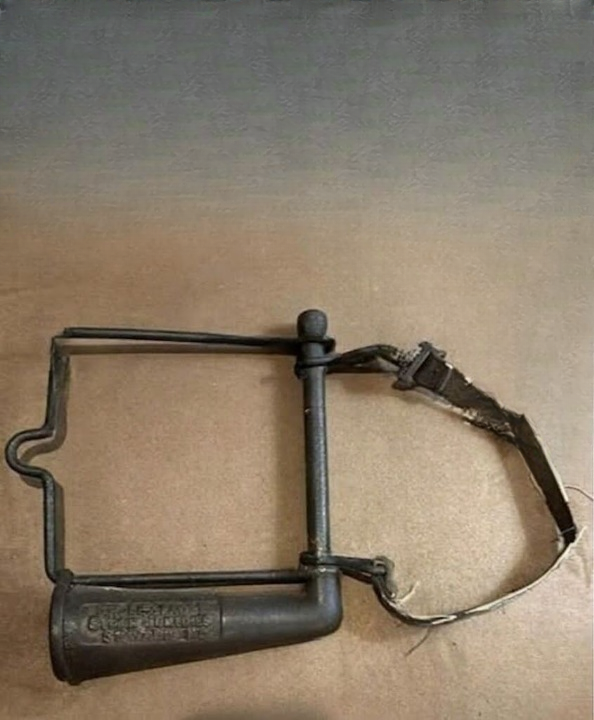
Today, when a horse becomes sick, owners can call veterinarians equipped with advanced diagnostic tools, mobile imaging machines, medications, and emergency surgical care. Modern animal medicine moves quickly, efficiently, and with a level of precision people a century ago could barely imagine.
But hidden away in dusty barns, abandoned farmhouses, and antique collections across America is a strange brass object that tells the story of a very different time.
At first glance, most people have no idea what it is.
Some mistake it for an old musical instrument. Others think it might be industrial equipment, part of a lantern, or even a decorative relic from another era. Yet this unusual brass device once played a critical role in keeping America alive and moving.
It was called a horse drencher—and long before modern veterinary clinics existed, it helped save thousands of horses that entire families depended on to survive.
To understand why this strange tool mattered so much, you have to understand what horses once represented in everyday American life.
Before automobiles, tractors, and engines transformed transportation and farming, horses were the backbone of the country. They plowed fields, hauled freight, transported families, carried soldiers into war, and powered local economies. In rural America especially, losing a horse wasn’t simply emotional—it could destroy a family financially.
A single healthy draft horse could determine whether crops were planted on time, supplies were delivered, or a farm survived the winter.
That’s why horse illness terrified farmers.
One of the most dangerous conditions was colic, a painful digestive disorder that could become fatal very quickly. Horses suffering from severe colic often became restless, collapsed, refused food, or showed signs of intense abdominal pain. Without treatment, many died.
The problem was that professional veterinary care was rare in isolated farming communities during the nineteenth and early twentieth centuries. Families often had to rely on homemade remedies, practical knowledge, and specialized tools to care for their animals themselves.
That is where the brass horse drencher became essential.
The device was designed to administer liquid medicine directly into a horse’s stomach safely and efficiently. While it may look crude today, it represented surprisingly thoughtful engineering for its time.
Most horse drenchers were made from heavy cast brass fitted with thick leather straps. Brass wasn’t chosen for appearance alone. Farmers and metalworkers valued it because it resisted corrosion, held up under rough use, and could withstand constant exposure to medicinal liquids.
The design itself was clever.
A wide funnel sat at the top, allowing caretakers to pour liquid remedies into the instrument. A hollow metal tube connected to a specialized bit that fit into the horse’s mouth. Leather straps secured the device to the animal’s head during treatment.
Once positioned correctly, medicine could flow directly down the horse’s throat while minimizing waste and reducing the risk of spilling expensive remedies.
For frightened farmers treating a thousand-pound animal in distress, this tool often represented hope.
Modern audiences sometimes underestimate how much skill these procedures required. Horses in pain could panic violently, making treatment dangerous for both the animal and the handler. Yet generations of caretakers learned to use these tools carefully because they had no alternative.
In many ways, the horse drencher reflected the practical ingenuity that defined early rural America.
People built solutions with the materials and knowledge they had available.
And despite its mechanical simplicity, the drencher helped countless animals survive illnesses that might otherwise have been fatal.
Today, surviving examples have become highly valued among collectors of agricultural antiques and veterinary history. Estate sales, rural auctions, and antique barns occasionally reveal forgotten drenchers covered in dust and tarnish.
Collectors carefully inspect several details to determine authenticity and value:
- The quality and weight of the brass
- Original leather straps and stitching
- Presence of the funnel attachment
- Signs of genuine wear from barn use
- Manufacturer markings or stamps
Some rare, well-preserved examples sell for surprisingly high prices because they represent an important piece of agricultural and medical history.
But beyond monetary value, the horse drencher carries a deeper significance.
It reminds us how closely human survival once depended on animal welfare.
Today, many people experience animals primarily as companions or pets. But for earlier generations, caring for horses was directly tied to food production, transportation, income, and survival itself. A sick horse could threaten an entire household’s stability.
That reality created a powerful relationship between people and working animals—one built not only on utility, but often on deep responsibility and care.
The drencher also reflects the evolution of veterinary science.
As medicine advanced during the twentieth century, safer and more effective treatment methods gradually replaced these older mechanical devices. Flexible stomach tubes, improved medications, scientific research, and professional veterinary training dramatically changed equine healthcare.
By the 1950s, traditional horse drenchers had largely disappeared from practical use.
Yet many veterinarians and historians still view them with respect.
Not because the tools were perfect, but because they represented an important step in the long process of improving animal medicine. They showed how people observed animal anatomy, adapted available materials, and engineered practical solutions long before modern technology existed.
For antique enthusiasts, finding one today can feel almost surreal.
The brass often carries a worn golden glow from decades of handling. The leather may be cracked with age, still faintly smelling of barns, dust, and oil. Every scratch and dent hints at emergencies long forgotten—late nights in cold stables, worried farmers, frightened horses, and desperate attempts to save an animal that meant everything to a family.
And perhaps that is why these strange relics continue to fascinate people.
They are not merely objects.
They are evidence of human resilience.
They tell stories about survival, innovation, and compassion during a time when life was far harsher and far less predictable than it is today.
So the next time you come across an unfamiliar brass device tucked away in an old barn or antique shop, pause before dismissing it as junk.
You might be looking at a forgotten tool that once helped save the animals that built America itself.