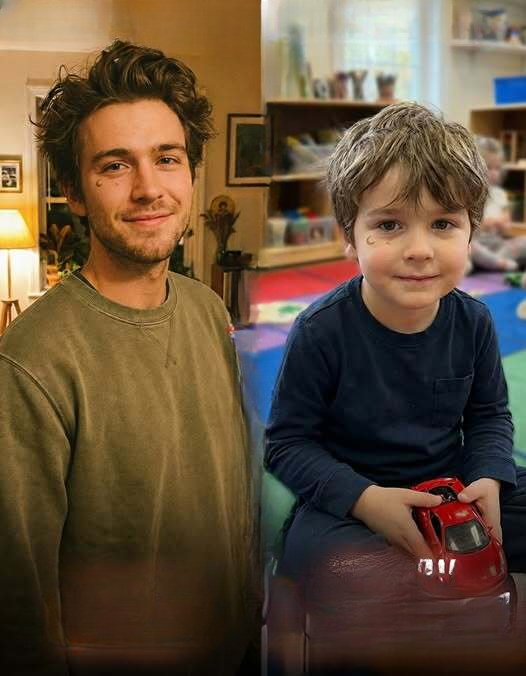
When my only son died, I stopped believing in second chances.
It wasn’t a dramatic decision. It didn’t feel like a choice at all. It felt like something inside me simply closed—like a door locking quietly and never opening again.
Owen was nineteen when I got the phone call.
I still remember the exact sound of it. The way the officer’s voice tried to stay steady, as if careful words could soften what they were about to say.
“There’s been an accident… your son—”
After that, everything blurred. The mug he left on the counter. Still warm. The half-written note on the kitchen table. His shoes by the door, untouched.
People came. They brought food I didn’t eat, flowers I didn’t remember receiving, and condolences I couldn’t process.
I remember standing at the cemetery thinking the world should feel different.
But it didn’t.
It just kept going.
And I didn’t know how to go with it.
Five years passed like that.
Not healing.
Not moving on.
Just… continuing.
I became Ms. Rose again—because I already was before Owen died. Kindergarten teacher. Reliable. Calm. The one who always had tissues, bandages, and stickers ready for small emergencies that made sense.
Children don’t ask questions grief can’t answer. They just live in the moment in front of them.
“Ms. Rose, look what I drew!”
“It’s perfect,” I would say, even when it was a purple dog with wings and three eyes.
And for a while, that routine became the only thing holding me together.
Until a Monday morning that looked exactly like every other Monday morning.
The school hallway was loud with tiny footsteps and backpacks dragging across the floor. Someone was crying because their sandwich had the wrong crust. Someone else was proud because they lost a tooth.
Normal chaos.
Safe chaos.
Then the principal stepped into my classroom.
“Ms. Rose, we have a new student,” she said.
Behind her stood a small boy. Maybe five or six years old. Messy brown hair. Nervous hands gripping a dinosaur backpack like it was the only solid thing in his world.
“This is Theo,” she said gently. “He just transferred.”
I knelt down instinctively, smiling the way teachers do when they want a child to feel safe immediately.
“Hi, Theo. Welcome.”
He didn’t answer right away. Just studied me quietly.
And then I saw it.
A small crescent-shaped birthmark under his right eye.
The exact same mark Owen had.
My body reacted before my mind could catch up. My breath stopped. My hands went cold in a way that felt physically impossible.
For a moment, I forgot where I was.
The classroom stayed loud, but it sounded far away—like it belonged to another world.
Theo tilted his head slightly, the same way Owen used to do when he was trying to understand something carefully.
And something inside me cracked open.
Not like grief this time.
Like recognition.
The rest of the morning passed in fragments.
I taught phonics. Read stories. Helped tie shoes. Sang cleanup songs off-key while trying to stay steady.
But my eyes kept returning to Theo.
The way he hummed while coloring.
The way he shared his snack without being asked.
The quiet concentration in his expression when he was thinking.
Small things.
But they didn’t feel small.
They felt familiar in a way that made my chest hurt.
After school, I stayed late organizing supplies I didn’t need to organize.
I told myself I was just delaying the quiet.
Theo sat nearby, flipping through an alphabet book, humming softly under his breath.
Owen used to hum like that.
I told myself it meant nothing.
Then the classroom door opened.
A woman stood there.
Older than I remembered her. Tired in a way that looked like it had been earned over years, not days.
But I knew her immediately.
Ivy.
Owen’s girlfriend.
The room went silent in a way that felt unnatural.
Theo ran to her instantly.
“Mom! Can we get chicken nuggets?”
Mom.
That word didn’t land gently.
It hit like impact.
I looked at Ivy, and before I could stop myself, I asked the question forming in my chest for years without permission.
“Is he Owen’s child?”
Her face tightened.
Not in surprise.
In fear of being seen.
“Yes,” she whispered.
The word didn’t feel real at first.
It took a second to settle.
Then everything inside me shifted at once.
Theo wasn’t just a reminder of Owen.
He was what remained of him.
A living continuation of the son I had buried.
Ivy spoke quickly after that, voice shaking.
“I didn’t know how to tell you. After he died… I couldn’t reach out. I didn’t know what kind of pain I was adding to yours.”
Pain.
As if anything could be added to what already existed.
I looked at Theo again.
He was watching us carefully now, sensing tension without understanding it.
Not afraid.
Just aware.
“I’m not here to take him,” I said finally, carefully choosing each word. “I just… want to know him. I want to be part of whatever is left of Owen.”
Silence followed.
Heavy. Complicated. Honest.
Ivy’s husband arrived a few minutes later. Mark. He didn’t try to interrupt or control the moment. He just listened.
“This can’t become a fight,” he said quietly. “It has to be about Theo.”
And he was right.
Because Theo wasn’t a memory.
He was a child.
So we didn’t decide anything that day.
We agreed on something slower.
Counseling. Boundaries. Time.
A way to build something that didn’t destroy what already existed.
The following weekend, we met at a small diner.
Theo arrived first, already halfway through a stack of pancakes.
When he saw me, he smiled like I was someone he already trusted.
“Ms. Rose! I saved you chocolate chips!”
And just like that, something in me broke in a different way.
Not into pieces this time.
Into softness.
I sat beside him. We colored. We laughed. We shared food. Simple things that somehow felt enormous.
At one point, Theo leaned gently against my arm while humming.
The same tune Owen used to hum when he was small.
I stopped breathing for a moment.
Not from grief.
From something else.
Something dangerously close to hope.
And I finally understood something I had not been ready to understand for five years:
Grief doesn’t end when someone is gone.
But sometimes, life refuses to let love end with it.
And what returns isn’t a replacement.
It’s a continuation—quiet, unexpected, and fragile enough that you learn to hold it differently the second time.