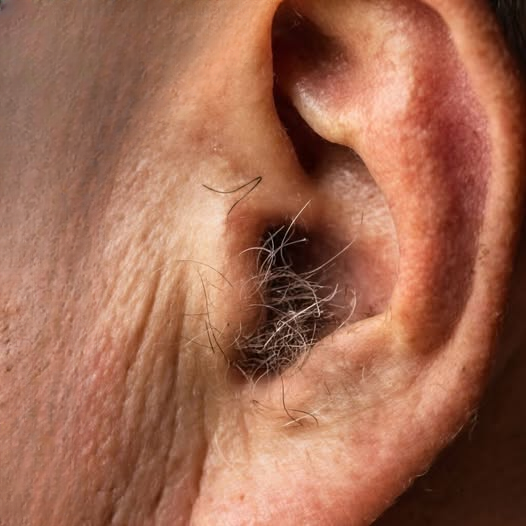
For many people, the first time they notice hair growing on their ears comes as a surprise.
It may appear gradually — a few stray hairs near the outer ear, thicker strands around the edges, or fine growth that suddenly seems more visible in the mirror. Some people laugh it off, others feel embarrassed, and many quietly wonder whether it signals a health problem.
But despite the myths and jokes surrounding ear hair, the reality is much less dramatic.
Hair growth on the ears is usually a completely normal part of aging, influenced primarily by hormones, genetics, and the natural changes the body experiences over time.
Why Ear Hair Becomes More Noticeable With Age
As humans age, the body changes in complex and uneven ways.
One of the most noticeable changes involves hair growth patterns. While hair on the scalp may become thinner or recede, hair in other areas — such as the ears, eyebrows, and nose — may grow thicker or more visible.
This happens because hair follicles respond differently to hormonal changes depending on where they are located on the body.
The process is especially common in older men, though women can experience it as well.
The Role of Hormones
Hormones play a major role in determining where hair grows and how thick it becomes.
Two important hormones involved are:
- Testosterone
- Dihydrotestosterone (DHT)
These hormones belong to a group called androgens, which influence hair growth throughout life.
As people age, hair follicles in certain areas become increasingly sensitive to these hormones. In some places, like the scalp, this sensitivity may contribute to thinning hair. In others — including the ears and nose — it can stimulate additional growth.
That’s why it’s possible to lose hair in one area while gaining it somewhere else.
Genetics Matter Too
Not everyone develops visible ear hair to the same degree.
Genetics strongly influence:
- Hair density
- Thickness
- Growth speed
- Distribution patterns
If older relatives in your family had noticeable ear or nose hair, there’s a good chance you may experience similar changes over time.
Some people naturally produce finer, lighter hair that remains barely visible, while others develop thicker or darker strands.
Ear Hair Is Not a Sign of Illness
One of the biggest misconceptions about ear hair is that it signals poor health, disease, or hormonal imbalance.
In most cases, this simply isn’t true.
Ear hair is generally considered a normal age-related change rather than a medical concern.
Despite internet rumors and old myths, there is no strong scientific evidence linking ordinary ear hair growth to:
- Heart disease
- Poor circulation
- Organ failure
- Serious hormonal disorders
Unless accompanied by other unusual symptoms, ear hair alone is not considered a warning sign of illness.
Why Humans Have Ear Hair at All
Ear hair actually serves a practical biological purpose.
Fine hairs around and inside the ears help:
- Trap dust and debris
- Reduce the entry of insects or particles
- Protect sensitive areas of the ear canal
These protective functions become more noticeable as hair growth patterns change with age.
In many ways, ear hair is simply the body continuing to do what it has always done — only more visibly.
Why Men Usually Notice It More
Men are more likely than women to develop prominent ear hair because they typically have higher androgen levels throughout life.
However, women may also notice increased facial or ear hair after menopause.
This occurs because estrogen levels decline during menopause, changing the balance between estrogen and androgens in the body. As a result, certain types of hair growth may become more visible.
Again, this is usually a normal hormonal shift rather than a medical issue.
Does Trimming Ear Hair Make It Grow Back Thicker?
This is one of the most common myths about hair.
The answer is no.
Cutting or trimming hair does not change:
- The number of hair follicles
- Hair growth speed
- Hair thickness at the root
However, trimmed hair often feels coarser because the blunt cut edge is more noticeable than a naturally tapered hair tip.
This creates the illusion that the hair has become thicker, even though its actual structure hasn’t changed.
Safe Ways to Groom Ear Hair
Whether to remove ear hair is entirely a personal choice.
Some people leave it alone, while others prefer occasional grooming for cosmetic reasons.
If you choose to trim ear hair, safety is important.
Recommended options include:
- Small electric ear trimmers
- Rounded grooming scissors
- Professional grooming services
Avoid:
- Inserting sharp tools deep into the ear canal
- Aggressive plucking
- Waxing sensitive inner ear areas without professional guidance
The skin around the ears can be delicate, and improper grooming may cause irritation or injury.
Aging and the Changing Human Body
Ear hair is just one of many visible reminders that the body evolves over time.
Other common age-related changes include:
- Gray hair
- Wrinkles
- Changes in skin texture
- Slower metabolism
- Thicker eyebrows or nose hair
While society often treats aging as something to resist or hide, many of these changes are simply evidence of a body adapting and enduring over decades of life.
Why People Feel Embarrassed About It
Cultural beauty standards tend to celebrate youth and minimize visible signs of aging.
As a result, normal features like ear hair often become the subject of jokes or embarrassment.
But biologically speaking, ear hair is no more unusual than graying hair or laugh lines.
Understanding the science behind these changes can help replace unnecessary shame with perspective and acceptance.
When Should You See a Doctor?
In most cases, ear hair is harmless.
However, it’s worth consulting a healthcare professional if you notice:
- Sudden extreme hair growth
- Pain or irritation
- Skin changes around the ears
- Unusual hormonal symptoms
These situations are uncommon, but medical advice can help rule out underlying conditions when necessary.
Final Thoughts
Hair growing on the ears is not mysterious, dangerous, or abnormal.
It is usually the result of:
- Natural aging
- Hormonal changes
- Genetics
- Time
Far from being a flaw, ear hair is simply another reminder that the human body changes continuously throughout life.
And while modern culture may encourage people to hide every sign of aging, there is something deeply human about accepting these changes for what they are: evidence of a life lived over many years.
So if you notice ear hair appearing as you get older, there is usually no reason for alarm.
It’s not a disease.
It’s not a secret warning.
It’s simply biology doing what biology has always done.