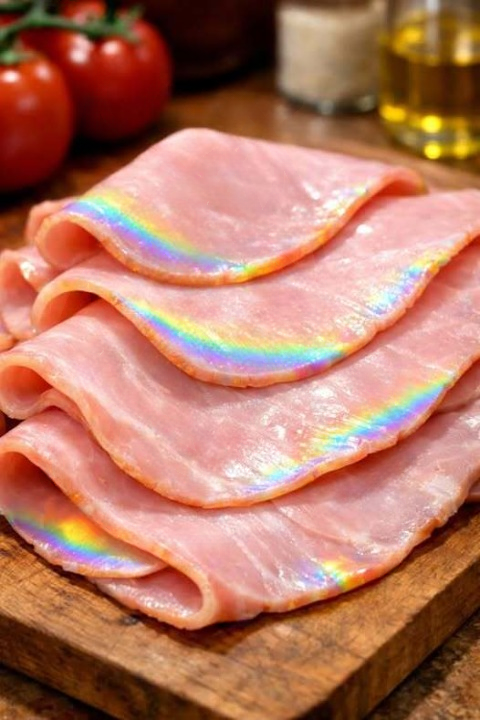
It’s a moment that catches many people off guard.
You open a fresh package of deli ham, expecting the usual soft pink slices. Instead, under the kitchen light, something unexpected appears. Subtle streaks of green, blue, purple, and even faint gold shimmer across the surface.
At first glance, it can look alarming.
Is it spoiled? Is it contaminated? Is something wrong with the food?
For many people, that strange rainbow sheen is enough to make them hesitate—or even throw the meat away entirely.
But the truth is far less concerning than it looks.
In most cases, that shimmering effect has nothing to do with spoilage at all. Instead, it is a natural optical phenomenon known as iridescence, and it is far more common in processed meats than most people realize.
What You’re Actually Seeing
Deli ham is made from muscle tissue that has been cured, compressed, and sliced into extremely thin layers. On a microscopic level, muscle fibers are arranged in tight, repeating structures.
When those fibers are cut cleanly and evenly, they create a surface that interacts with light in a very specific way.
Instead of reflecting light in a single uniform color, the surface causes light waves to scatter, overlap, and interfere with one another. This is what produces the shifting rainbow effect.
It is the same general principle seen in soap bubbles, oil slicks on water, or the surface of a compact disc.
The colors are not actually “in” the meat. They are created by light bending across microscopic structures on the surface.
That’s why the effect changes depending on the angle you look at it or how the light hits it. Move the package slightly, and the colors shift or disappear entirely.
Why Deli Meat Shows It More Often
Not all meats display this effect, and deli ham is particularly prone to it for a few reasons.
First, processed meats are sliced extremely thin using industrial equipment. This creates very smooth, uniform surfaces—ideal conditions for light interference.
Second, curing changes the structure of muscle proteins and introduces salt, which helps the meat retain moisture. That moisture forms a thin reflective layer on the surface, making the optical effect even more visible.
Third, vacuum-sealed packaging keeps the surface moist and smooth until it is opened, which can enhance the rainbow sheen when the meat is first exposed to air and light.
Because of these factors, deli ham, turkey, roast beef, and similar products are more likely to show iridescence than whole cuts of meat or rougher textures.
Why It Used to Cause Confusion
Before modern food science explained this phenomenon, many people understandably assumed the worst when they saw it.
After all, we are trained to associate unusual colors in food with danger. Green or purple tones in meat naturally raise concerns about spoilage or contamination.
For years, the rainbow sheen led some consumers to believe the meat had gone bad or had been exposed to chemicals. Others assumed it was an early sign of bacterial growth.
However, food safety experts, including agencies like the United States Department of Agriculture, have clarified that iridescence alone is not a sign of spoilage.
It is purely a physical effect caused by light interaction—not microbial activity.
That said, appearance should never be the only factor in judging whether food is safe to eat.
What Spoiled Deli Meat Actually Looks and Smells Like
While iridescence is harmless, spoiled meat shows very different and much clearer warning signs.
The first and most reliable indicator is smell.
Fresh deli ham has a mild, slightly salty aroma. When it spoils, it develops a sour, sharp, or ammonia-like odor that is difficult to ignore. This is caused by bacteria breaking down proteins and fats.
Texture is another key indicator.
Fresh slices should feel slightly moist but still firm. If the meat becomes sticky, slimy, or leaves residue on your fingers, it is likely no longer safe to eat.
Color changes that do not shift with light are also important. Iridescence moves and changes depending on angle. Spoilage does not behave that way. Persistent dull gray patches, dark green discoloration, or visible mold growth are all clear signs the meat should be discarded.
The Role of Time and Storage
Even when deli meat looks normal, time plays a major role in safety.
Once opened, sliced deli meats typically last only a few days in the refrigerator. Most food safety guidelines recommend consuming them within three to five days when properly stored.
Refrigeration slows bacterial growth but does not stop it entirely. Exposure to air, repeated opening of packaging, and fluctuating temperatures can all accelerate spoilage.
Proper storage helps extend freshness. Keeping the meat tightly sealed, minimizing air exposure, and storing it in the coldest part of the refrigerator are all important steps. However, even with perfect storage, deli meats are still highly perishable.
Why the Rainbow Effect Is Still Common Today
Despite advances in food processing, iridescence remains a normal and expected phenomenon.
In fact, modern slicing techniques may make it even more noticeable. Today’s industrial slicers produce extremely smooth, uniform surfaces that are ideal for light interference.
Vacuum sealing also preserves moisture, which enhances reflectivity when the package is opened.
Rather than being a defect, the rainbow sheen is simply an unavoidable result of precision food manufacturing combined with natural physics.
Why Understanding It Matters
It’s easy to see why people react cautiously when they notice something unusual in their food. Food safety awareness is important, and caution is never a bad instinct.
But understanding the difference between optical effects and actual spoilage can prevent unnecessary food waste and confusion.
The rainbow colors on deli ham are not a warning sign. They are simply light behaving in a way that becomes visible under the right conditions.
What looks strange at first is often just a reminder that even everyday foods are shaped by complex scientific processes happening on a microscopic level.
The Bottom Line
Rainbow-colored deli ham may look unusual, but in most cases, it is completely safe to eat. The effect is caused by iridescence, an optical phenomenon created when light interacts with the structure of thinly sliced, cured meat.
The true signs of spoilage remain consistent and easy to identify: foul odor, slimy texture, and persistent discoloration that does not change with light.
In the end, what appears alarming on the surface is often just physics at work. And sometimes, the most unsettling-looking things in your kitchen are not warnings at all—just the quiet science of light revealing itself in an unexpected way.