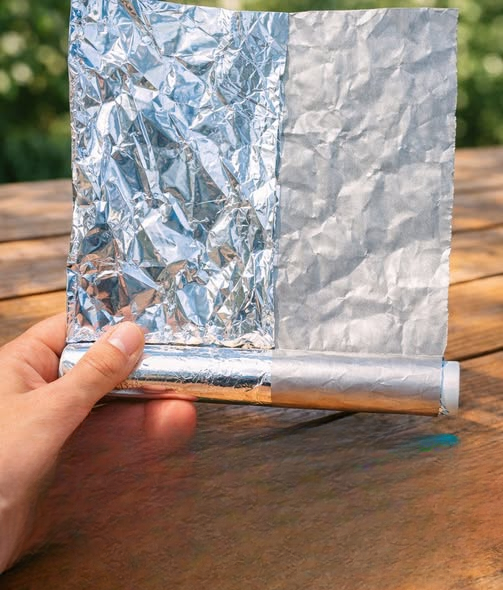
Have you ever paused in the middle of wrapping leftovers or lining a baking tray and wondered why aluminum foil looks different on each side? One side is bright and reflective, almost mirror-like. The other appears softer and matte. It’s a small detail, but it sparks a surprisingly common question: does it matter which side you use?
Everyday household items often have subtle design features that go unnoticed. For instance, small holes in certain product caps are engineered for safety and airflow, and pasta-serving spoons often include a center opening designed to measure a portion of dry spaghetti. Similarly, aluminum foil has a two-sided appearance that seems intentional—but the reason behind it isn’t what most people expect.
In this comprehensive guide, we’ll explore why aluminum foil has a shiny side and a dull side, how it’s manufactured, whether the sides function differently, common myths, proper usage tips, and practical applications for cooking, baking, storage, and beyond. By the end, you’ll understand not only the science behind aluminum foil but also how to use it more effectively in your kitchen.
What Is Aluminum Foil?
Aluminum foil is a thin sheet of aluminum metal that has been rolled into flexible layers. It is widely used for:
-
Wrapping food
-
Lining baking trays
-
Covering dishes
-
Insulating items
-
Grilling and roasting
-
Food storage
Because aluminum is lightweight, flexible, resistant to corrosion, and an excellent conductor of heat, it has become one of the most versatile tools in modern kitchens.
One of the most recognizable brands in North America is Reynolds Wrap, though many manufacturers produce similar products worldwide.
The Visual Difference: Shiny vs. Matte
When you tear off a sheet of aluminum foil, you’ll notice:
-
One side is highly reflective and glossy.
-
The other side looks dull or matte.
At first glance, it may seem like the shiny side is coated with something or treated differently. Some people assume one side reflects heat while the other absorbs it. Others believe one side is “stronger” or “safer” for cooking.
In reality, the difference is far simpler—and it comes down to manufacturing.
How Aluminum Foil Is Made
To understand the two sides, you need to know how aluminum foil is produced.
Step 1: Mining and Refining
Aluminum begins as bauxite ore. Through refining processes, the ore is converted into alumina and then smelted into pure aluminum metal.
Step 2: Rolling the Metal
Large aluminum slabs are passed through heavy rollers that gradually flatten the metal into thinner and thinner sheets. This process is called milling or rolling.
Here’s the key detail:
When aluminum foil becomes extremely thin (as thin as 0.016 mm for standard household foil), it is too delicate to roll individually. If manufacturers attempted to roll a single ultra-thin sheet alone, it would tear.
To prevent this, two sheets of aluminum are rolled together at the same time.
Step 3: The Surface Effect
When two sheets are rolled simultaneously:
-
The sides pressed against the polished steel rollers become shiny.
-
The sides pressed against each other develop a duller finish.
This happens because:
-
The roller surfaces are smooth and polished.
-
The contact between the two aluminum sheets prevents both inner surfaces from becoming glossy.
After rolling, the sheets are separated. Each sheet ends up with:
-
One shiny side (contact with roller)
-
One dull side (contact with another sheet)
That’s it—no coatings, no special treatment, no secret function.
Does It Matter Which Side You Use?
For standard household aluminum foil, the answer is simple:
It does not matter which side touches the food.
According to major manufacturers, both sides function the same way in terms of:
-
Heat conduction
-
Food safety
-
Structural strength
The difference is purely cosmetic.
The Heat Reflection Myth
One of the most common beliefs is that:
-
The shiny side reflects heat.
-
The dull side absorbs heat.
While it’s true that polished metal surfaces can reflect slightly more radiant heat than matte ones, the difference in household aluminum foil is minimal—so minimal that it has no noticeable impact in typical cooking scenarios.
When baking or roasting:
-
Heat transfer occurs primarily through conduction (direct contact).
-
The temperature difference between sides is negligible.
In other words, flipping the foil will not significantly change cooking time or results.
When the Shiny Side Might Matter
There are a few specialized exceptions worth mentioning.
Some heavy-duty or non-stick aluminum foils are manufactured with coatings or treated surfaces. In these cases:
-
One side may be labeled “non-stick.”
-
The treated side should face the food.
However, for regular aluminum foil without special coatings, both sides are interchangeable.
Always check the packaging instructions if using a specialty product.
Aluminum Foil in Cooking and Baking
Aluminum foil plays a vital role in many cooking methods.
1. Roasting
Foil can be used to:
-
Line baking trays
-
Tent meats to prevent over-browning
-
Retain moisture during cooking
2. Grilling
Foil packets (often called “foil packs”) are popular for grilling vegetables, fish, and meats. The foil helps seal in juices and simplifies cleanup.
3. Baking
Foil can:
-
Prevent crust edges from over-browning
-
Cover casseroles
-
Create makeshift lids
4. Food Storage
Aluminum foil protects food from:
-
Air exposure
-
Light
-
Moisture loss
Is Aluminum Foil Safe for Food?
Aluminum foil is generally considered safe for normal cooking and food storage. However, certain factors can influence how it performs.
Acidic Foods
Highly acidic foods—such as tomato sauce or citrus-heavy dishes—can react slightly with aluminum. This reaction may cause minor discoloration but is not typically harmful in short-term cooking.
For long-term storage of acidic foods, glass or food-grade containers are often preferred.
High Heat Cooking
Aluminum foil performs well at high oven temperatures. However, it should not be used in microwave ovens unless explicitly permitted by the appliance manufacturer, as metal can cause sparks.
Creative Uses Beyond the Kitchen
Aluminum foil is surprisingly versatile outside of cooking.
Cleaning Aid
Crumpled foil can help:
-
Scrub pots and pans
-
Polish silver (when used with proper cleaning solutions)
Sharpening Scissors
Cutting through folded foil sheets can help sharpen dull scissors.
Protecting Surfaces
Foil can shield stovetops or baking trays from spills.
Environmental Considerations
Aluminum is recyclable. Clean foil can be placed in recycling bins in many municipalities.
Tips for recycling:
-
Remove food residue.
-
Rinse lightly if needed.
-
Ball up small pieces into a larger mass for easier sorting.
Recycling aluminum uses significantly less energy than producing new aluminum from raw materials.
Common Questions About Aluminum Foil
Why Does Aluminum Foil Tear Easily?
Because it is extremely thin, especially standard household versions. Heavy-duty foil is thicker and more resistant to tearing.
Can Aluminum Foil Go in the Air Fryer?
Yes, but airflow must not be blocked. Always follow appliance guidelines.
Is “Tin Foil” Actually Made of Tin?
No. Modern household foil is made from aluminum. The term “tin foil” is a historical carryover from earlier materials.
Comparing Standard vs. Heavy-Duty Foil
Standard Foil
-
Thin and flexible
-
Ideal for wrapping and covering
Heavy-Duty Foil
-
Thicker and more durable
-
Better for grilling or lining pans
Both types still have one shiny and one dull side due to the same manufacturing process.
Why the Myth Persists
The shiny vs. dull debate continues because:
-
The visual difference suggests purpose.
-
Heat reflection is a real scientific concept.
-
Cooking advice is often passed down informally.
However, manufacturers consistently confirm that the sides are functionally identical for everyday use.
Practical Kitchen Tips for Using Aluminum Foil
-
Use heavy-duty foil for grilling.
-
Double-layer foil for extra durability.
-
Avoid tightly sealing foil around rising baked goods.
-
Do not use foil in microwave ovens unless appliance instructions allow it.
-
Label wrapped leftovers with dates.
The Science of Heat Transfer in Cooking
To better understand why the sides don’t matter, consider how heat works in ovens.
Cooking relies primarily on:
-
Conduction (direct heat transfer from pan to food)
-
Convection (circulating hot air)
-
Radiation (heat waves)
The small difference in surface finish between foil sides does not significantly alter these processes.
Fun Fact: Why Foil Feels Cold
Metal feels cold because it conducts heat away from your skin quickly—not because it’s actually colder than surrounding air.
Final Thoughts: Mystery Solved
The shiny and dull sides of aluminum foil are simply the result of how the metal is rolled during manufacturing. Two sheets are pressed together to prevent tearing, and the surfaces touching the rollers become glossy while the inner surfaces remain matte.
There is no hidden coating, no special chemical treatment, and no meaningful performance difference between the sides in everyday cooking.
So the next time you tear off a sheet of aluminum foil, you can confidently use either side facing up or down. The choice is purely aesthetic.
Sometimes, the most intriguing household mysteries turn out to have surprisingly straightforward explanations—and aluminum foil is a perfect example.
By understanding how it’s made and how it works, you can use this versatile kitchen essential with greater confidence and clarity.