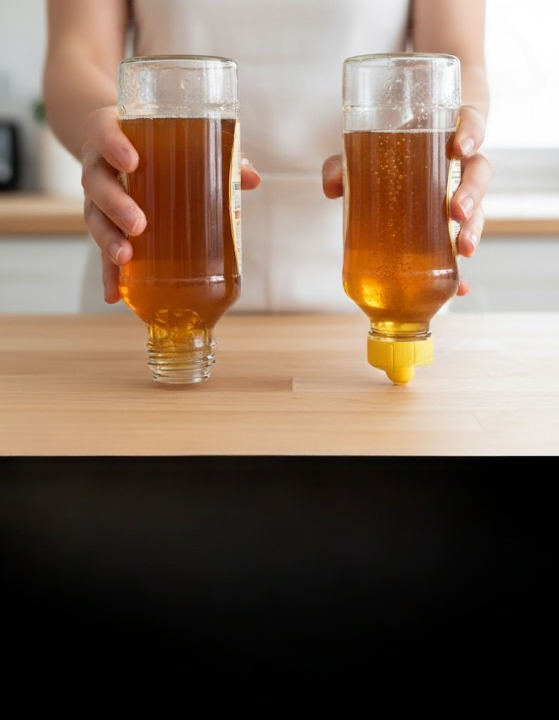
When it comes to choosing natural foods, honey is one of those products people tend to trust without thinking too much about what’s inside the bottle. It has a reputation for being pure, healthy, and minimally processed, which is why it’s often referred to as “liquid gold.” However, not all honey sold in stores is truly pure, and that has led to a wave of simple home “tests” people use to judge quality.
One of the most widely shared methods online is the so-called bottle flip trick. The idea is simple: turn the honey bottle upside down and watch how it flows. If it moves slowly, people assume it is real honey. If it flows quickly, they assume it has been diluted or mixed with additives. At first glance, this seems like an easy way to separate good honey from low-quality or fake versions. But in reality, the situation is more complicated than it appears.
The reason this method became popular is rooted in the natural properties of honey. Pure honey is thick and dense because it contains a high concentration of natural sugars and very little water. Under normal conditions, this thickness causes it to move slowly inside a container. This is what leads many people to believe that flow speed alone can be used as proof of authenticity.
However, honey is not a uniform substance, and its behavior can change significantly depending on external conditions. One of the biggest factors is temperature. When honey is stored in a warm environment, it naturally becomes thinner and flows more easily. In colder conditions, it becomes much thicker and may even crystallize over time. This means that the same jar of honey can behave very differently depending on where and how it is stored.
Another important factor is processing. Not all honey is sold in its raw form. Some products are filtered or pasteurized to improve shelf life, clarity, and texture. These processes can reduce natural thickness, making the honey appear more fluid even if it is still genuine. As a result, a perfectly authentic product might fail the bottle flip test simply because it has been processed for commercial use.
The container itself also plays a role. Different bottle designs—such as squeeze bottles, wide jars, or narrow-neck containers—can influence how quickly the honey moves when flipped. Even small differences in opening size or internal pressure can change the flow rate, making visual judgment unreliable.
Because of these variables, the bottle flip test can easily lead to false conclusions. It might label real honey as fake or give confidence in products that are not truly pure. In fact, some commercially produced honey alternatives are specifically designed to mimic the texture and appearance of real honey, making them even harder to distinguish using simple at-home methods.
This is why experts generally recommend more reliable approaches when evaluating honey quality. Instead of relying on a single visual test, it is better to use a combination of observations and purchasing decisions. For example, checking how honey behaves in different conditions can provide more useful clues. A small drop placed on a dry surface may hold its shape if it is thicker and more natural, while diluted versions tend to spread more quickly.
Another commonly mentioned method involves water. When pure honey is added to a glass of water, it tends to sink and settle at the bottom before dissolving slowly. Lower-quality or heavily diluted honey may dissolve more quickly, blending into the water without forming a distinct layer. While even this test is not perfect, it offers more context than a simple bottle flip alone.
Taste and aroma can also provide subtle hints. Natural honey often has a richer, more complex flavor profile depending on the flowers used by bees, while overly processed or artificial versions may taste overly uniform or overly sweet without depth. However, these differences can be subtle and may require experience to recognize.
Despite all these informal methods, the most reliable way to ensure honey quality is through informed purchasing choices. Reading product labels carefully is one of the most important steps. Genuine honey should ideally have minimal ingredients—often just “honey” itself. If the label includes added sugars, syrups, or artificial sweeteners, it is no longer pure honey in the traditional sense.
Certifications and sourcing information can also be helpful. Products that are certified by food safety authorities or labeled as raw, unfiltered honey are generally more trustworthy. Even better is purchasing directly from local beekeepers or trusted producers, where transparency about harvesting and production methods is clearer.
Understanding where honey comes from makes a significant difference. Local honey producers often rely on traditional beekeeping practices that preserve the natural structure of the product. This not only supports authenticity but can also help consumers avoid heavily processed alternatives.
It is also worth remembering that honey naturally varies from batch to batch. Factors such as floral source, season, and region all influence color, texture, and taste. A lighter honey may not necessarily be lower quality than a darker one, and viscosity alone does not determine purity.
In the end, while quick internet tricks like the bottle flip test may seem convenient, they rarely provide a complete or accurate picture. Honey is a natural product influenced by many environmental and processing factors, and reducing its evaluation to a single visual test can be misleading.
A more careful approach—combining label reading, trusted sourcing, and basic observation—offers a far better way to ensure quality. Instead of relying on shortcuts, taking a few extra moments to understand what you are buying leads to more reliable choices and a better appreciation of what real honey actually is.
True honey quality is not something that can always be confirmed with a single flip of a bottle. It comes from knowledge, awareness, and choosing products from sources you can trust.