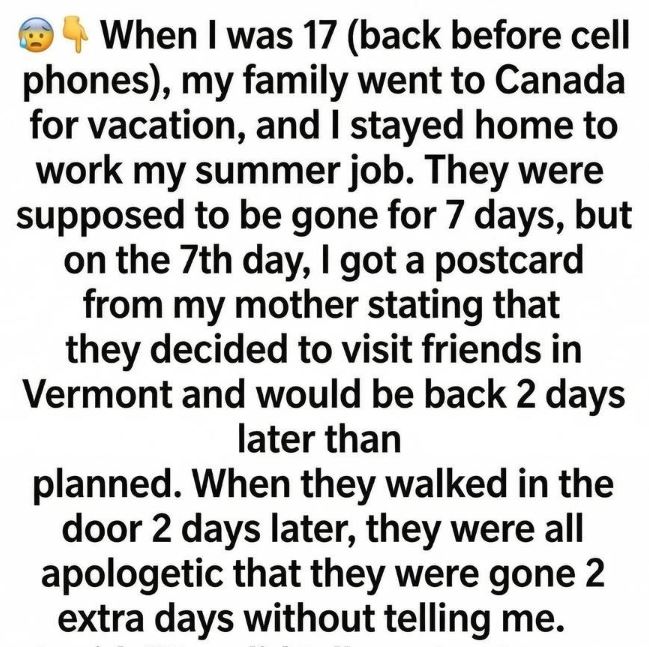
When I was seventeen, my family left for a summer trip to Canada and trusted me with the house. I told myself I was ready for the responsibility, even excited by it. A whole week alone sounded like freedom—late nights, uninterrupted quiet, and the kind of independence I had always imagined wanting.
But the moment the front door closed behind them, the house changed.
It wasn’t just empty. It felt enlarged, like every room had expanded just enough to remind me I was the only thing inside it. The usual sounds of life—conversation drifting from the kitchen, footsteps in the hallway, the faint hum of daily activity—were gone. What replaced them was something sharper: silence that had structure, silence that had weight.
By the second day, I had already developed routines just to cope with it. I kept the television on even when I wasn’t watching. I left lights on in rooms I wasn’t using. I made food I didn’t really want to eat just to create noise in the kitchen. Even sleep felt like an escape rather than rest.
By the fifth day, I started talking to myself out loud without realizing it.
By the seventh, I stopped noticing the difference between day and night.
That was when the postcard arrived.
The Message That Didn’t Make Sense
It came through the mail slot in the afternoon, sliding onto the floor with a soft scrape that sounded louder than it should have.
At first, I assumed it was just routine mail—advertisements, bills, something irrelevant. But when I picked it up, I recognized the handwriting immediately.
It was from my mom.
Her writing always had a slight curve to it, letters leaning gently forward like they were in a hurry to say something kind. The postcard itself showed a quiet landscape—trees, mountains in the distance, the kind of place people go to slow down.
The message was short.
They were doing well. The trip was going smoothly. And they had decided, at the last minute, to take a brief detour to Vermont before heading home. Just two days. Nothing unusual. Nothing to worry about.
I remember reading it once, then again.
And then sitting down on the floor because something in me had loosened all at once.
The house didn’t feel as empty after that. The silence softened. Even the light in the room felt less harsh. It was strange how quickly comfort returned just because someone, somewhere, had written a few reassuring lines.
For the first time in days, I slept without leaving the lights on.
The Return Home
Two days later, I heard the car pull into the driveway.
I remember running to the window before I even realized I was moving. They stepped out of the car carrying bags, tired but relaxed in the way people are after a long drive. Everything looked normal. Ordinary. Safe.
I met them at the door with the postcard in my hand.
“I loved the Vermont idea,” I said casually, trying to sound more composed than I felt. “That must’ve been fun.”
My mom paused before taking off her jacket.
“What Vermont idea?” she asked.
I laughed at first, thinking she was joking.
Then I handed her the postcard.
The moment she read it, her expression changed.
Not confusion at first—but stillness. The kind of stillness that doesn’t belong to casual misunderstanding.
“I didn’t send this,” she said quietly.
My dad looked over her shoulder. “That’s not your handwriting?”
She shook her head immediately. “No. It looks close, but it’s not mine.”
At that point, I thought there had to be a simple explanation. A mistake at the post office. A misdelivered card. Some harmless mix-up.
But then they looked closer.
The stamp was correct. The date matched the timeline. Even the ink looked right.
And yet none of it made sense.
Because they had not gone to Vermont.
They had driven straight home from Canada exactly as planned.
The Silence After the Explanation
That night, the postcard sat on the kitchen table like an unanswered question.
No one touched it.
We kept returning to it the way people return to something they don’t understand, hoping that looking longer might reveal what they missed. But the more we studied it, the less it made sense.
There was no evidence of anyone breaking in. No signs of mail interference. No additional strange letters before or after it. Nothing else out of place.
Just that single postcard.
Arriving exactly during the days I felt the most alone.
And saying exactly what I needed to hear.
At first, I tried to rationalize it. Maybe I had misread it. Maybe I had imagined part of it because I wanted reassurance so badly. Seventeen is not an age where loneliness feels small—it feels absolute. Maybe my mind had filled in gaps I didn’t realize were there.
But the postcard was real.
The handwriting was there.
The timing was real.
Only the source wasn’t.
The Uncomfortable Comfort
What unsettled me most was not fear.
It was comfort.
Someone had noticed a moment of isolation in my life and responded to it—not with harm, not with intrusion, but with reassurance carefully shaped to fit my situation. It wasn’t random. It wasn’t careless. It felt deliberate in a way that was almost gentle.
For a while, I couldn’t decide how to feel about that.
Part of me wanted to dismiss it as coincidence. Another part couldn’t ignore how precisely it aligned with what I needed in that moment. It didn’t warn me. It didn’t confuse me. It didn’t disrupt anything.
It simply softened a difficult week.
And that made it harder to understand, not easier.
Because comfort, when it appears without explanation, carries its own kind of uncertainty.
Life Moving Forward Without Answers
As time passed, the incident became something we talked about less and less. Eventually, we stopped trying to solve it altogether.
There were theories, of course. A misdirected postcard from a neighbor. A prank that never repeated itself. A strange coincidence that aligned too neatly with timing. But none of them held up under scrutiny, and none of them explained why there was never anything like it again.
The mystery remained untouched.
What stayed with me wasn’t the question of who sent it, but the feeling it left behind.
I began to notice how easily the mind accepts reassurance when it arrives in a familiar form. A message that sounds like someone we trust. A tone that feels safe. A sentence that arrives at the exact moment we need relief.
We don’t always question those things when we’re overwhelmed. We accept them because they ease something inside us.
That realization stayed longer than the postcard itself.
What the Experience Really Changed
Looking back now, I don’t see the postcard as something unsettling in the way I once did. I see it as something more complicated.
It didn’t harm me. It didn’t mislead me in any meaningful way. It gave me something I genuinely needed at the time: a break from fear I didn’t fully understand yet.
But it also revealed something about how fragile certainty can be.
We assume reassurance comes from known sources—family, friends, clear communication. Yet sometimes comfort appears in unexpected ways, and the mind accepts it first and asks questions later.
That doesn’t make it false in the emotional sense. It just makes it uncertain in origin.
And uncertainty, I’ve learned, is often more memorable than clarity.
The Lasting Question
I never found out who sent that postcard.
Maybe I never will.
But over the years, I’ve stopped trying to turn it into something it’s not. I no longer see it as a mystery that needs solving. I see it as a moment that revealed something quieter and more human.
The way we reach for stability when everything feels too still.
The way comfort can arrive without explanation.
The way the mind accepts peace when it is offered, even if it doesn’t fully understand its source.
Some experiences are not meant to be solved. They are meant to be understood in how they shaped us afterward.
And this one did exactly that.
Final Reflection
That postcard still sits somewhere in a drawer at my parents’ house.
We kept it, not because we ever figured it out, but because it represents something we couldn’t otherwise explain.
A moment of silence filled with unexpected reassurance.
A week of loneliness interrupted by a message that made everything feel lighter, even briefly.
And a reminder that not all mysteries are warnings.
Some are simply reminders of how deeply humans respond to comfort—even when its origin is unknown.
Because sometimes, the strangest part of life isn’t what we don’t understand.
It’s how easily we accept peace when it finally arrives.