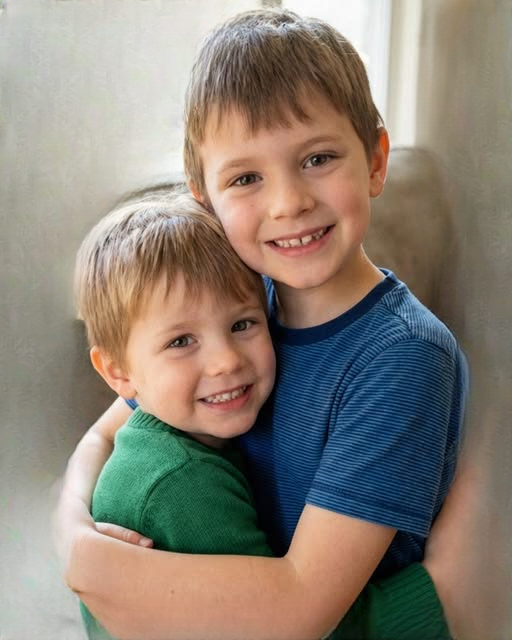
My son had only been back at kindergarten for a week when he climbed into the car, buckled halfway into his seat, and said it like he was talking about the weather.
“Mom, Ethan came to see me.”
For a second, I didn’t process the words. The parking lot noise—children laughing, parents calling goodbyes—kept moving normally around us. But something inside me didn’t.
Because Ethan had been dead for six months.
I kept my hands steady on the steering wheel. That was the first thing grief teaches you when you’re also raising a living child: don’t let your voice betray what your body is screaming.
“Oh, sweetheart,” I said gently. “You must be thinking about him today.”
But Noah shook his head.
“No. He was there. At school.”
The word there felt wrong. Like a door opening where there shouldn’t be one.
Ethan had been eight. Mark had been driving him to soccer practice when a truck drifted across the center line. One moment, a normal afternoon. The next, a phone call that split my life into before and after.
Mark survived.
Ethan didn’t.
I never saw him after that. The doctor said I didn’t need to. That I was “too fragile.”
As if grief could make a mother less entitled to her own child.
Now Noah—five years old, still soft with baby roundness in his cheeks—was telling me something that didn’t belong in any version of reality I understood.
“What did he say?” I asked carefully.
Noah smiled like this was the most normal thing in the world.
“He said you should stop crying.”
The air left my lungs in one slow collapse.
I buckled Noah in and drove home without speaking again.
But the road didn’t feel like the road anymore.
It flickered.
For a moment, I saw another road beneath it. Two lanes. A truck drifting left.
I gripped the wheel until my knuckles went white.
That night, I barely slept.
The next morning, I tried to convince myself it was imagination. Grief leaking into a child’s mind in strange ways. Kids say things. Kids pretend.
But Noah didn’t stop.
That Saturday, I took him to the cemetery.
White daisies in my hand. The sky too bright for how I felt inside.
Ethan’s headstone was still new. Too clean. Like it hadn’t fully accepted what it was meant to mark.
“Come say hi to your brother,” I said softly.
Noah didn’t move.
He stared at the stone for a long time. Then past it.
“Mom,” he whispered. “Ethan isn’t there.”
My stomach tightened. “What do you mean he isn’t there?”
“He told me,” Noah said simply. “He’s not inside it.”
A cold wave moved through me.
That word—told—didn’t belong here.
On Monday, it happened again.
“He came back,” Noah said in the car. “By the fence at school.”
My fingers tightened on the steering wheel.
“At school?”
He nodded.
“He talks to me.”
“What does he say?”
Noah hesitated. “It’s a secret.”
Everything in me went still.
“Noah,” I said carefully, “we don’t keep secrets from Mom. If anyone tells you to keep something from me, you tell me anyway. Okay?”
He nodded—but not confidently.
That night, I called the school.
The next morning, I was sitting in the kindergarten office asking for security footage before I even finished my greeting.
Ms. Alvarez looked uncertain. I wasn’t.
“My son is being approached,” I said. “I need to see what’s happening.”
Reluctantly, she pulled up the cameras.
At first, it was just children playing—bright jackets, scattered laughter, small chaos that looked harmless.
Then Noah drifted toward the back fence.
He stopped.
Smiled.
Waved.
“Zoom in,” I said.
A man crouched on the other side of the fence. Work jacket. Baseball cap low. Partially hidden, but close enough that Noah could see him clearly.
They were talking.
Noah laughed.
My vision narrowed.
The man slipped something through the fence.
Something small.
“Who is that?” I asked.
Ms. Alvarez swallowed. “He’s one of the contractors. Maintenance. He’s been fixing the exterior lights.”
But I wasn’t hearing contractor.
I was hearing memory.
A crash report I had avoided reading too closely.
A courtroom photo I had tried not to study.
“That’s him,” I said.
“Who?” she asked.
“The driver,” I whispered. “From the accident.”
The room went silent.
I called the police.
He was found near the maintenance shed twenty minutes later. He didn’t run. Didn’t resist.
When I arrived, they didn’t let me see him alone.
But I insisted on being present.
He sat in the small room with his cap off now. Thinner than I remembered. Eyes red. Hands folded tightly like he was holding himself together by force.
When he saw me, he stood slightly.
“Mrs. Elana,” he said quietly.
Hearing my name in his voice made something in me recoil.
Noah was with me, holding my sleeve.
“That’s Ethan’s friend,” he whispered.
I sent Noah out with Ms. Alvarez.
Then I turned back to the man.
“Why were you talking to my son?” I asked.
His face tightened immediately. “I didn’t mean to scare him.”
“You told him you were Ethan,” I said. “You told him to keep secrets.”
His shoulders dropped.
“I know,” he said.
Officer Haines stepped forward. “Name?”
“Raymond Keller,” he replied.
“Why approach the child?”
Raymond stared at the table. “I saw him at pickup. He looks like Ethan.” His voice cracked. “I got assigned to the repair job on purpose.”
The words hit hard.
“Why?” I demanded.
His hands shook.
“I can’t sleep,” he said. “Every time I close my eyes, I’m back on that road. I have episodes—fainting, dizziness. Doctors told me not to drive until I was cleared. I didn’t wait.”
My chest tightened.
“You drove anyway.”
He nodded.
“And my son died,” I said.
“Yes.”
The silence that followed felt heavy enough to bend the room.
“So you decided what?” I asked. “That you could fix that by talking to another child?”
“I thought…” He swallowed hard. “I thought if I helped him… if I helped you stop crying… maybe I could breathe again.”
I leaned forward slightly.
“So you used my living child to manage your guilt.”
He didn’t deny it.
He couldn’t.
Officer Haines confirmed a no-contact order. The school tightened security immediately. I made sure of it.
When Noah came back in, he was holding a plastic dinosaur from the office toy bin.
He looked confused. Small. Vulnerable in a way that made my chest ache.
I knelt in front of him.
“That man is not Ethan,” I said softly.
Noah’s eyes filled. “But he said—”
“He said something that wasn’t true,” I interrupted gently. “Grown-ups don’t give children secrets like that. And they don’t use children to carry grown-up pain.”
Noah blinked hard.
“So Ethan didn’t send him?”
My throat tightened so sharply it hurt.
“No,” I said. “Ethan didn’t.”
That was when he cried.
Not loudly.
Just the quiet collapse of a child realizing the world can be unsafe in ways you never explain in storybooks.
I held him until his breathing steadied.
When we got home, Mark was already there.
He had heard.
Of course he had.
He looked shaken in a different way than me—like anger and guilt were fighting inside him for space.
“I should’ve been the one driving,” he said quietly.
“Don’t,” I answered immediately. “We don’t get to rewrite it. We only get to move forward.”
Two days later, I went to the cemetery alone.
The wind was sharp, cutting through my coat.
Ethan’s name was still there.
Still real.
Still final.
“I’m sorry,” I whispered. “I couldn’t protect you.”
The silence didn’t answer.
But it also didn’t accuse.
For the first time, it just… existed.
“I won’t let anyone speak for you again,” I said. “Not fear. Not guilt. Not strangers trying to borrow your name.”
I placed my hand on the stone.
“And I will keep Noah safe.”
Standing there, I realized something painful but steady:
Grief doesn’t disappear when truth arrives.
But it does change shape.
It stops being confusion.
And becomes something you can finally carry without breaking under it.