I thought I knew every chapter of my husband’s life.
Twenty-eight years of marriage has a way of convincing you that nothing essential can be hidden between two people. You learn each other’s rhythms, the small predictable habits that make up a shared life. Daniel stirred his coffee counterclockwise—three slow turns, every morning. He hummed under his breath when he was thinking, always slightly off-key. He folded the newspaper in the exact same way every Sunday, even when news moved online and the paper became optional.
We were not a flashy couple. Not dramatic. Just steady. Familiar. Safe.
We didn’t have children. That was the one quiet absence in our home—never spoken about too loudly, but always present in the background like a soft echo. Still, we built a life that felt full enough: Sunday grocery trips, evening walks when weather allowed, shared silence on the couch while old detective shows played in the background. There were no secret bank accounts. No unexplained trips. No reason, I believed, to question the shape of the life we had built.
Or so I thought.
Daniel died suddenly.
A heart attack in our driveway.
One moment we were arguing lightly about repainting the fence—something trivial, something domestic. The next, I was kneeling beside him on cold concrete, gripping his hand while strangers shouted instructions and an ambulance arrived too late to matter. I remember begging him to stay with me, like love alone could negotiate with biology.
It couldn’t.
He was gone before we reached the hospital.
The funeral came quickly after that. Too quickly for my mind to catch up. The world moved forward while I stood still.
The service was small. Family, a few coworkers, neighbors who always waved when we passed. I stood near the casket and repeated thank-yous until the words became hollow sounds without meaning. People told me stories about Daniel—how kind he was, how dependable, how quietly generous. I nodded because that’s what you do when your life becomes a public memory.
That’s when I saw him.
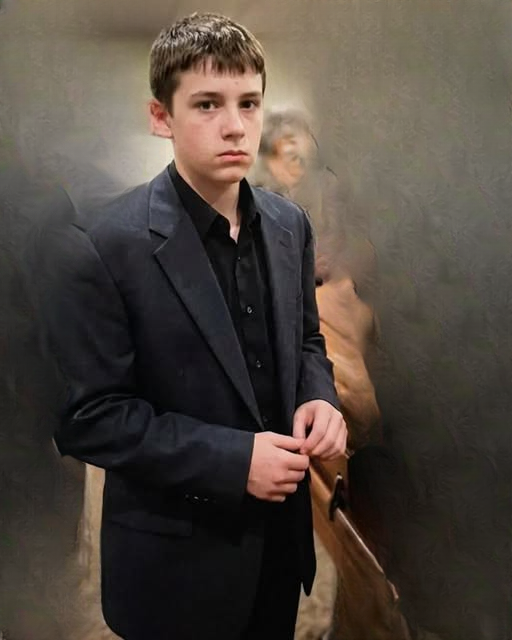
A teenage boy stood near the back.
He looked about fifteen, maybe sixteen. Tall, but still carrying the unevenness of adolescence—shoulders slightly too narrow for his height, jacket too big, hands twisting together as if he wasn’t sure what to do with them. He didn’t talk to anyone. He just watched me.
Not in a casual way.
In a waiting way.
When the crowd thinned, he walked toward me.
“I’m sorry for your loss,” he said politely.
“Thank you,” I replied automatically.
Then he swallowed, like the next words had weight.
“He told me that if anything ever happened to him… you would take care of me.”
For a second, I genuinely thought I had misheard him.
“I’m sorry?” I said. “Who are you?”
“My name is Adam.”
The world didn’t collapse in an instant. It tilted. Just slightly. Enough to make everything feel unreliable.
A secret son.
An affair.
A second life I had somehow missed for nearly three decades.
My throat tightened. “I think there’s been a mistake. This is a private service.”
“He told me to come,” Adam said quietly.
But grief has a strange way of sharpening pain into something defensive. I turned away before he could say anything else. I didn’t ask questions. I didn’t look at him again.
At the burial, I kept my sunglasses on even though the sky was gray. People spoke about Daniel’s kindness, his integrity, his devotion. Each word felt like a quiet accusation. I stood there thinking about a boy I didn’t know and a man I thought I did.
That night, after the house finally emptied, silence returned—but it wasn’t comforting anymore.
It felt loaded.
I went to Daniel’s office.
I don’t know what I expected to find. Proof of something. A mistake. A misunderstanding I could resolve with logic. The safe was behind a framed landscape we had hung together years ago. I knew the combination. We had always said we had nothing to hide.
Inside were documents. Insurance papers. Financial records.
And a photograph.
A woman holding a baby.
On the back, in Daniel’s handwriting, were three words that made my chest tighten:
Donna and baby Adam.
The baby looked no older than a few months.
Fifteen years ago.
“You lied to me,” I whispered into the empty room, though there was no one there to answer.
My mind scrambled for explanations. Late nights. Volunteer work he never spoke much about. The mentoring program he said helped underprivileged teens across town. I had always admired that part of him. I had called it compassion.
Now it felt like something else I hadn’t yet understood.
The next afternoon, I drove to the cemetery again. I didn’t know what I planned to say. I only knew I couldn’t sit in unanswered questions.
But Adam was already there.
Standing near Daniel’s grave.
I walked straight toward him, anger breaking through before grief could stop it.
“What was Donna to my husband?” I demanded, holding up the photograph. “Are you his son?”
Adam flinched. “No.”
“Then explain this.”
He looked at the photo carefully, then at me.
“Please,” he said. “Let me tell you.”
Something in his tone made me hesitate.
“I’m listening,” I said, though my arms stayed crossed.
“Daniel wasn’t my father,” Adam began. “He was my court-appointed guardian.”
The words landed differently than I expected. He wasn’t a secret son. He was something more complicated.
“My mom and Daniel were friends in college,” he continued. “She’s Donna. Years later, she struggled with addiction. My biological father left when I was little. When things got bad, she reached out to Daniel.”
I felt the anger inside me shift—still present, but less certain.
“He helped us,” Adam said. “At first just small things. Then more. Eventually the court made him my legal guardian.”
He hesitated.
“My mom didn’t want anyone to know about her addiction. Daniel respected that. He said it wasn’t his story to tell.”
The wind moved through the cemetery, cold and slow.
“He told me if anything happened to him,” Adam added, “you would make sure I finished school. He set up an education trust. You’re listed as co-trustee.”
That sentence changed everything again.
I left him there without another word and drove straight to Daniel’s lawyer.
Mr. Collins looked tired, but not surprised when I asked about Adam.
“Yes,” he said, opening a file. “Daniel became legal guardian five years ago. He also established an education trust for him.”
He slid the documents toward me.
My husband’s signature was there. Official court seals beside it.
I stared at the paper like it might rearrange itself into something simpler.
“Why didn’t he tell me?” I asked.
“Donna requested confidentiality regarding her circumstances,” Mr. Collins said gently. “Daniel intended to tell you eventually.”
Eventually.
A word that now felt too late.
A memory surfaced without warning.
Eight months before Daniel died, we had been washing dishes together. He had asked, almost casually, “How would you feel about taking guardianship of a child someday?”
I remembered laughing. “Where did that come from?”
“We never had kids,” he said softly. “Maybe we could help someone who needs it.”
“I’d like that,” I had said. “If we did it, I’d want to give a kid stability.”
He had looked relieved in a way I didn’t understand then.
Now I did.
Later that day, I called Adam.
We met again at the cemetery.
The light was fading, softening everything it touched.
“I spoke to Mr. Collins,” I said.
He nodded, tense.
“I’m sorry I assumed the worst,” I admitted.
“I understand,” he said quietly.
“I’m still hurt he didn’t tell me,” I continued. “But I understand why he kept his promise.”
Silence settled between us, not uncomfortable this time—just heavy.
“I’m going to continue the trust,” I said. “You’ll finish school. That part won’t change.”
His eyes widened slightly. “You mean that?”
“Yes,” I said. “Daniel trusted me with it. I won’t break that trust now.”
For a moment, he looked younger than he had at the funeral. Less like a stranger. More like a kid who had been waiting too long for certainty.
“Thank you,” he said. “He always said you were stronger than you thought.”
I looked at Daniel’s name carved into stone.
“You should have trusted me with the whole truth,” I said softly.
But even as I said it, something inside me shifted.
Because this wasn’t betrayal in the way I first believed.
It was complexity.
A promise made quietly. A life intersecting with another life I never knew existed. A man trying, imperfectly, to do right by people who depended on him.
Daniel hadn’t left me a secret life to uncover.
He had left me a responsibility to carry.
And standing there beside a teenage boy who no longer felt like a stranger, I understood something I hadn’t been ready to see before:
Grief doesn’t only reveal what we’ve lost.
Sometimes, it reveals what we’ve been trusted with.