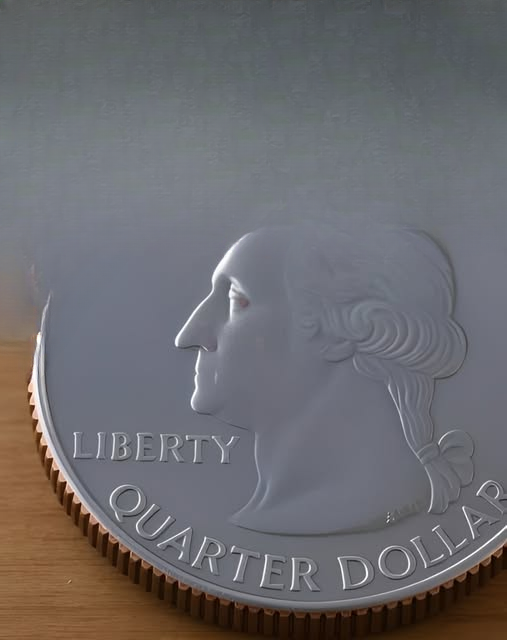
Take a moment and think about the coins in your pocket or purse. If you have a quarter or a dime nearby, run your finger gently along its edge. You’ll notice a series of tiny grooves circling the entire rim. These ridges, known formally as “reeding,” may seem like a simple decorative touch. Many people assume they are there for grip or appearance. However, those fine lines carry a surprisingly rich history—one rooted in economic protection, craftsmanship, and the evolution of modern currency systems.
Far from being random design choices, ridged coin edges emerged from centuries of financial challenges. They were developed to address a very real problem that once threatened the stability of economies. Over time, these ridges became a lasting symbol of how innovation can solve practical problems in subtle but powerful ways.
In this in-depth exploration, we’ll examine where ridged coins came from, why they were created, how they continue to function today, and what they reveal about the relationship between trust, design, and money.
What Are Coin Ridges, Exactly?
The technical term for the ridges along the edge of certain coins is “reeding.” Coins that feature this design are called “reeded coins.” If you look closely at a U.S. quarter or dime, you’ll see evenly spaced vertical grooves running along the outer rim.
In the United States, ridges appear on several denominations produced by the United States Mint, including:
-
United States quarter
-
United States dime
-
United States half dollar
By contrast, the United States nickel and United States penny have smooth edges.
Why the difference? The answer lies in history.
The Original Problem: Coin Clipping
To understand the purpose of ridges, we need to go back several centuries—long before digital payments, paper currency security threads, or electronic banking.
In earlier periods of history, coins were often made from precious metals such as gold and silver. Their value wasn’t just symbolic; it was directly tied to the metal content. If a coin contained a certain amount of silver, it was worth that amount of silver.
This system worked well—until people discovered a loophole.
A practice known as “coin clipping” began to spread. Individuals would shave off tiny slivers of precious metal from the edges of coins. Each individual clipping was small and difficult to detect. But over time, those tiny shavings added up. A dishonest individual could accumulate a meaningful quantity of gold or silver while leaving the clipped coins in circulation.
The clipped coins still looked legitimate at a glance. However, their weight—and therefore their true value—had been reduced.
If this practice became widespread, it could destabilize entire monetary systems. Trust in currency depends on consistency. Once people suspect that coins might not contain the promised value, confidence in trade begins to erode.
Governments needed a solution.
The Birth of Reeding as a Security Feature
The answer came in the form of edge design.
By adding evenly spaced ridges around a coin’s perimeter, mints created a built-in tamper-evident system. If someone attempted to shave metal from a ridged coin, the grooves would be disrupted immediately. Even a small alteration would be noticeable.
This innovation transformed coin edges from smooth and vulnerable to textured and protected.
The concept spread widely during the 17th and 18th centuries, particularly in Europe and North America. By the time the United States Mint began producing coins in the late 18th century, reeding had become an established anti-fraud measure.
In effect, ridges were one of the earliest forms of anti-counterfeiting technology.
Why It Mattered So Much
At first glance, shaving tiny pieces off coins might seem minor. But in economies dependent on metal-backed currency, even small distortions could create serious ripple effects.
If coin clipping became widespread:
-
The total metal content in circulation would shrink.
-
Coins would lose weight and intrinsic value.
-
Merchants might begin weighing coins individually.
-
Trust in the monetary system could decline.
Economic stability depends on predictable value. Reeding helped protect that predictability.
By making tampering visible, ridges discouraged fraud and preserved public confidence in currency.
The Transition Away From Precious Metals
Over time, many countries—including the United States—shifted away from precious metal coinage. By the mid-20th century, rising silver prices made it impractical to continue producing certain coins from solid silver.
Today, most U.S. coins are made from base metals and layered alloys rather than high-value silver or gold. For example, modern quarters and dimes are composed primarily of copper and nickel.
If coins are no longer made from precious metals, why keep the ridges?
There are several reasons.
Modern Functions of Coin Ridges
Although coin clipping is no longer a widespread concern, ridges continue to serve practical purposes.
1. Tactile Identification
Ridges help people distinguish coins by touch. This is especially helpful for individuals with visual impairments.
By feeling the edge of a coin, someone can quickly determine whether it is a dime or quarter rather than a nickel or penny. The tactile difference improves usability and accessibility.
2. Machine Verification
Many vending machines, coin counters, parking meters, and laundry facilities still accept coins. These machines often rely on sensors that measure size, weight, and edge characteristics.
Reeded edges contribute to accurate recognition. The texture helps machines differentiate legitimate coins from foreign objects or counterfeits.
3. Design Tradition and Consistency
Currency design carries tradition. Removing ridges from coins that have featured them for generations might cause confusion or reduce familiarity.
Consistency supports public trust. When designs change too drastically, people may hesitate or question authenticity. Maintaining ridges preserves continuity with the past.
Coin Design as a Reflection of National Identity
Coins are more than payment tools. They also serve as cultural artifacts.
U.S. coins often feature prominent historical figures, including:
-
George Washington on the quarter
-
Abraham Lincoln on the penny
These designs communicate national history and values.
Edge details, though subtle, are part of that broader visual language. The decision to retain reeding reflects not only practicality but respect for tradition.
The Broader Evolution of Currency Security
Ridges were an early example of currency protection. Over time, security features evolved dramatically.
Modern banknotes incorporate:
-
Watermarks
-
Security threads
-
Microprinting
-
Color-shifting inks
Coins, too, use precise metallurgy and minting techniques that are difficult to replicate.
While ridges alone no longer prevent all forms of fraud, they remain part of a layered security approach.
The Economics of Trust
Money works because people trust it.
Whether dealing in coins, paper bills, or digital transactions, the value of currency depends on shared belief. When trust erodes, economies suffer.
Ridges were introduced to preserve that trust. They signaled that authorities were actively protecting the integrity of coinage.
Even today, small design features contribute to a sense of legitimacy. A coin that feels “right” in weight, texture, and appearance reinforces confidence.
Coins in a Digital World
The rise of credit cards, mobile wallets, and online banking has reduced reliance on physical currency in many regions.
However, coins still play roles in:
-
Public transportation systems
-
Parking infrastructure
-
Vending services
-
Small cash transactions
While usage patterns may evolve, physical currency remains part of everyday life.
And as long as coins circulate, their design features—including ridges—retain relevance.
Insights for Coin Collectors
For numismatists (coin collectors), ridges can provide clues about minting periods and authenticity.
Examining:
-
Edge uniformity
-
Groove depth
-
Wear patterns
can help determine a coin’s history and condition.
Collectors often study edge design alongside imagery and inscriptions to assess rarity and value.
Lessons for Designers and Innovators
The story of coin ridges offers broader lessons:
1. Small Details Can Solve Big Problems
A simple design change can address complex systemic risks.
2. Prevention Is More Effective Than Correction
Ridges deterred fraud before it could spread widely.
3. Security and Aesthetics Can Coexist
Reeding enhances both function and visual appeal.
4. Tradition Builds Trust
Maintaining familiar elements supports long-term confidence.
A Symbol of Adaptation
Throughout history, economies have faced challenges—from counterfeiting to inflation to technological disruption.
Coin ridges represent one chapter in the ongoing story of adaptation. They show how institutions respond creatively to threats while preserving usability.
Even as digital currencies and electronic payment systems expand, the lessons behind reeding remain relevant: protect integrity, maintain trust, and design with intention.
Conclusion: More Than Just Grooves
The next time you hold a ridged coin, consider what those tiny grooves represent.
They are:
-
A safeguard born from economic necessity
-
A tactile tool for accessibility
-
A design tradition carried forward through generations
-
A reminder that trust underpins every financial system
What seems like a minor texture is actually the result of centuries of innovation.
Coin ridges may be small, but their story is vast. They reflect humanity’s ongoing effort to balance practicality, security, and stability in something as fundamental as money itself.
In a world where financial systems continue to evolve, those modest grooves serve as a quiet testament to how thoughtful design can protect economies—and endure for centuries.