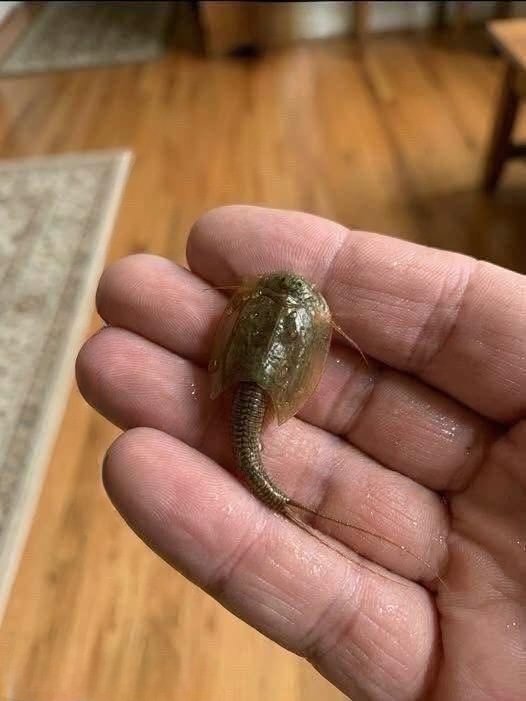
After a heavy rainstorm, one homeowner made an unexpected discovery in a waterlogged drainage ditch that quickly sparked curiosity. At first glance, the tiny creature looked unlike anything they had seen before. It had a strange, prehistoric appearance, moved rapidly through the muddy water, and seemed almost out of place in such an ordinary setting.
Not knowing whether it was harmless or potentially dangerous, they carefully collected it in a glass container and brought it indoors for a closer look. What they eventually learned transformed a moment of confusion into a fascinating lesson about one of nature’s oldest surviving creatures.
An Unusual Discovery After the Rain
Heavy rainfall often creates temporary pools of water in low-lying areas, drainage ditches, and fields. These short-lived habitats may seem lifeless, but they can suddenly become home to a surprising variety of aquatic creatures.
While inspecting a flooded trench after a storm, the homeowner noticed something darting through the muddy water. Unlike insects or tadpoles commonly found in standing water, this creature had a broad shield-like body, numerous tiny legs, and a long tail extending behind it.
Its unusual appearance immediately raised questions.
Was it an invasive species?
Could it be harmful?
Or was it simply an unfamiliar native animal?
Curiosity won over uncertainty, and the small animal was carefully transferred into a clear glass jar for observation.
A Closer Look Revealed Something Extraordinary
Under better lighting, the creature’s features became much easier to examine.
Its body appeared armored, almost resembling a tiny horseshoe crab. Beneath the shell, dozens of small legs moved constantly as it explored the bottom of the container. It occasionally stirred up sediment while searching for food, displaying behavior unlike that of common aquatic insects.
After comparing photographs and consulting reliable wildlife resources, the mystery was finally solved.
The strange animal was identified as a Triops, commonly known as a tadpole shrimp.
Despite its intimidating appearance, Triops are completely harmless to people and are considered one of the most fascinating freshwater crustaceans in the natural world.
What Exactly Is a Triops?
Triops are small freshwater crustaceans that belong to a very ancient group of animals. Although they resemble miniature horseshoe crabs, they are more closely related to other crustaceans such as shrimp and crabs.
One of the most remarkable facts about Triops is that they have existed in nearly the same form for hundreds of millions of years. Because their body structure has changed very little over immense periods of time, they are often called “living fossils.”
Their prehistoric appearance often surprises people who encounter them for the first time.
Why Do They Suddenly Appear After Rainstorms?
One of the most fascinating characteristics of Triops is their unique survival strategy.
Their eggs are capable of remaining dormant in dry soil for years, and in some cases even decades. These tiny eggs can withstand extreme heat, drought, and freezing conditions while waiting for the right environment.
When heavy rain fills temporary pools, ponds, or roadside ditches, the dormant eggs hatch within a short period.
This explains why Triops can seem to appear almost overnight in places that looked completely dry only days earlier.
As temporary pools eventually dry out, adult Triops die, but they leave behind a new generation of drought-resistant eggs that remain hidden until the next suitable rainfall.
Are They Dangerous?
Although their appearance may seem intimidating, Triops pose no threat to humans.
They do not bite, sting, or produce venom.
Instead, they spend most of their lives searching the bottom of shallow pools for food.
Their diet commonly includes:
- Algae
- Organic plant material
- Tiny aquatic invertebrates
- Decaying leaves
- Small microorganisms
In fact, Triops often help recycle organic matter within temporary freshwater habitats.
Why Scientists Find Them So Interesting
Triops are valuable to scientists because they provide insight into how ancient species survive in changing environments.
Their ability to produce eggs that remain dormant for extended periods is an extraordinary adaptation. This allows entire populations to survive unpredictable weather patterns and temporary habitats that may disappear within weeks.
Researchers also study Triops to better understand:
- Evolutionary biology
- Temporary freshwater ecosystems
- Survival strategies in extreme environments
- Dormancy and hatching mechanisms
Their resilience demonstrates just how adaptable life can be.
What Should You Do If You Find One?
If you discover a Triops after heavy rainfall, there is usually no reason for concern.
Observing it briefly can be an enjoyable learning experience, especially for children interested in nature.
However, it is generally best to return the animal to the same body of water where it was found. Temporary pools are part of its natural habitat, and removing wildlife permanently from the environment is rarely beneficial.
If you’re unsure about the identity of any unfamiliar creature, consider taking clear photographs and consulting local wildlife organizations or natural history experts rather than relying solely on online speculation.
Nature Is Full of Hidden Surprises
Most people walk past puddles, drainage ditches, and temporary pools without giving them a second thought. Yet these overlooked places can become home to remarkable creatures that have survived virtually unchanged since long before humans existed.
What initially appeared to be a strange and possibly alarming discovery turned out to be an opportunity to learn about one of nature’s oldest survivors.
The next time heavy rain transforms ordinary ground into shallow pools of water, take a closer look. You may never know what fascinating wildlife is waiting just beneath the surface.
Sometimes the most extraordinary discoveries are hiding in the most ordinary places, reminding us that the natural world still holds countless surprises for those willing to slow down and observe.